Democracy vs Dictatorship: 10 Shocking Differences You Should Know
Introduction:
Imagine walking into a voting booth and casting your ballot for the leader you want. Now imagine a scenario where that same choice doesn’t exist—where a single person or small group makes every major decision for your country, and you have no say in the matter. These two worlds represent fundamentally different ways of organizing society, and understanding the democracy vs dictatorship debate is crucial for anyone who wants to comprehend how our world actually works.
We live in a time of political uncertainty. Democratic movements are surging in some parts of the world while authoritarian governments tighten their grip in others. Breaking down what these systems actually are, how they differ, and what makes each one tick isn’t just academic—it’s essential for understanding current events, protecting our freedoms, and making informed decisions about the kind of society we want to live in.
This guide breaks down everything you need to know about these two fundamentally different political systems. Whether you’re a student researching government systems, a curious citizen wanting to understand politics better, or someone interested in how democracies and dictatorships operate, you’ll find clear, practical information backed by real-world examples.
What Is Democracy ?
What is democracy? At its core, democracy is a system of government where power ultimately rests with the people. The word itself comes from Greek: “demos” (the people) and “kratos” (power). In a democratic government, citizens have a meaningful say in how they’re governed, typically through voting, holding elected officials accountable, and participating in the political process.
But democracy isn’t just about voting. It’s a comprehensive approach to governance built on several fundamental principles:
Key features of democracy include:
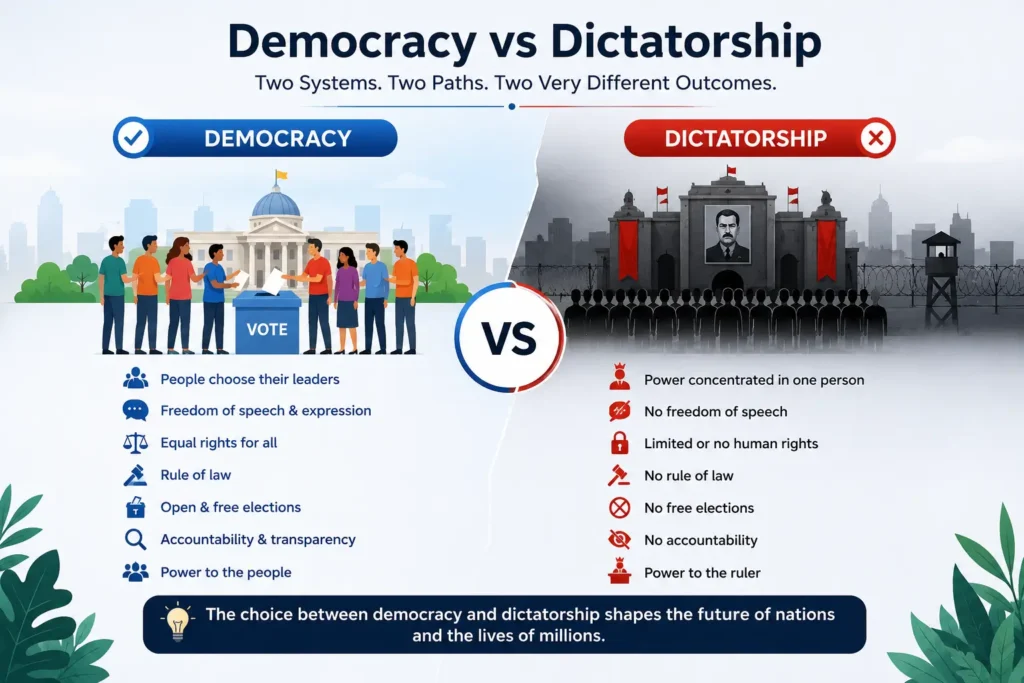
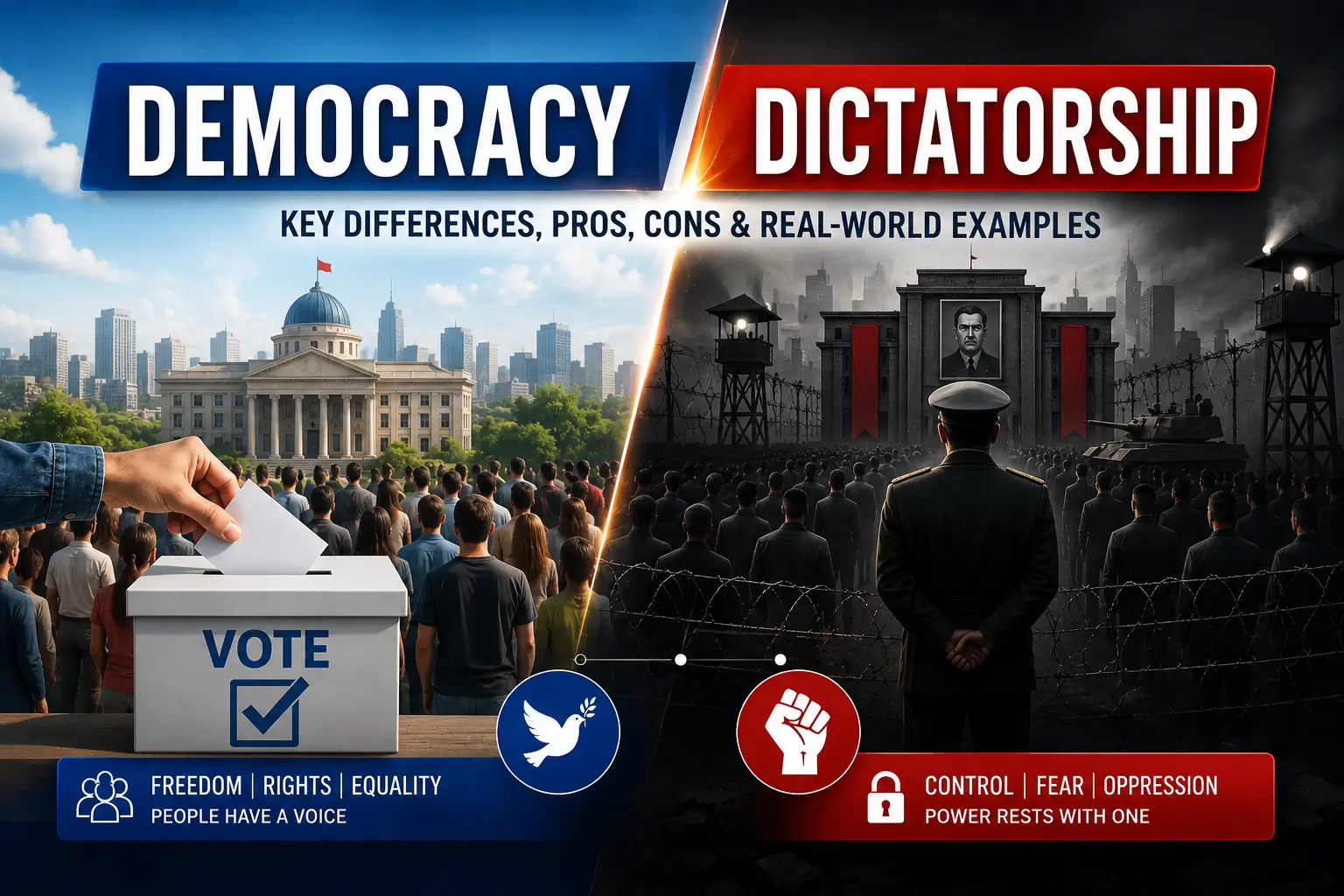
Power is distributed among different branches of government—executive, legislative, and judicial—so no single person or group becomes too powerful. This system of checks and balances keeps everyone accountable. Citizens have the right to vote in free and fair elections without intimidation or manipulation. Freedom of speech and press allows people to express their views, criticize the government, and access information. The rule of law means everyone, including government officials, must follow the law. There’s no one above it.
People can form political parties, join civil organizations, and participate actively in government. Independent courts protect individual rights and ensure justice. Peaceful transitions of power happen when one elected leader’s term ends and another takes over.
Real democracy examples show how this works in practice. Countries like Canada, Germany, Japan, and Costa Rica are recognized democracies where citizens regularly vote, political parties compete freely, and independent courts operate. The United States, despite its flaws, maintains democratic institutions with regular elections, freedom of the press, and constitutional protections for individual rights.
What Is Dictatorship ?
A dictatorship is a form of government where a single person or small group holds absolute power with little to no checks on their authority. Unlike democracy, which distributes power and protects individual rights, a dictatorial government centralizes power in the hands of one leader or ruling elite.
An authoritarian government operates very differently from how democracies function. Power doesn’t come from the people through elections—it usually comes from military force, inheritance, or the ruler’s ability to consolidate control.
Key features of dictatorship include:
One person or small group makes all major decisions without meaningful input from citizens. Elections either don’t exist, are completely controlled, or are merely theater—the outcome is predetermined. Independent media is suppressed or controlled. Journalists who criticize the regime face imprisonment or worse. The government enforces compliance through secret police, surveillance, and sometimes violence. Dissent isn’t tolerated. Political opponents face arrest, torture, or execution. Citizens have minimal say in government decisions or policies. Loyalty to the leader or regime is demanded and enforced.
Real dictatorship examples include North Korea, where Kim Jong Un holds absolute power and has inherited control from his father and grandfather. Syria under Bashar al-Assad has operated as a dictatorship for decades, with the ruler controlling all aspects of government. Zimbabwe under Robert Mugabe for 37 years, Venezuela under Hugo Chávez and Nicolás Maduro, and Cuba under Fidel Castro all demonstrate different variations of dictatorial rule.
Democracy vs Dictatorship: Quick Comparison Table
| Aspect | Democracy | Dictatorship |
|---|---|---|
| Power Source | Citizens through voting | Single person or small group |
| Leadership Selection | Free and fair elections | Inheritance, military force, or consolidation |
| Citizens’ Rights | Protected and guaranteed | Severely restricted |
| Freedom of Speech | Protected right | Heavily suppressed |
| Rule of Law | Everyone follows the law | Ruler is above the law |
| Media Independence | Free and independent | State-controlled |
| Checks and Balances | Multiple branches of government | Concentrated power |
| Political Participation | Citizens actively involved | Citizens excluded |
| Peaceful Transitions | Leaders change through elections | Power transitions through force or inheritance |
| Accountability | Officials answer to citizens | Leader answers to no one |
Key Differences Between Democracy and Dictatorship
Understanding the concrete differences between these systems helps clarify why each produces such different outcomes for citizens and societies.
Leadership Selection: How Leaders Come to Power
In a democratic government, leaders are chosen through elections. Citizens vote, ballots are counted fairly, and the candidate with the most votes wins. This process repeats at regular intervals, forcing leaders to earn public support to stay in power.
In a dictatorship, leaders rarely come to power through genuine elections. Instead, they might seize power through a military coup, inherit the position from a family member, or consolidate control gradually through manipulation. Once in power, they often eliminate mechanisms that could challenge their authority.
Think about it this way: a democratic leader must convince millions of people they deserve the job. A dictator only needs to control the military, secret police, or key power structures.
Citizen Rights: Who Has a Say?
Democracy guarantees broad rights to citizens. You can speak your mind, criticize the government, form groups with others who share your views, and participate in the political process. These aren’t gifts the government grants—they’re fundamental rights that the system is designed to protect.
Dictatorships don’t recognize these rights. Instead, dictators tightly control what citizens can say, do, and even think. Free expression is dangerous to authoritarian rule, so it’s suppressed. Citizens might have nominal rights on paper, but these aren’t enforced or protected in practice.
Freedom of Speech and the Press
Free speech is the oxygen of democracy. When people can speak their minds without fear, they can debate ideas, hold leaders accountable, and create social movements.
In authoritarian governments, freedom of speech and press is either completely absent or severely restricted. Journalists reporting on government corruption risk imprisonment. Social media is monitored or blocked. Books are banned. The government controls the narrative, and alternative voices are silenced.
Rule of Law: Is Everyone Equal Before the Law?
In democracies, the rule of law means everyone—from the average citizen to the president—must follow the law. If a leader breaks the law, they can be prosecuted. This principle creates accountability and predictability.
Dictators operate above the law. They make the rules but don’t follow them. What’s illegal for citizens is perfectly fine for the ruler. This creates a system of arbitrary rule where power comes from force, not law.
Media Independence: Who Controls Information?
Independent media is crucial to democracy. Newspapers, television stations, and online outlets report on government activities, investigate corruption, and present different viewpoints. Citizens access diverse information and make informed decisions.
Under dictatorship, media is either state-controlled or heavily censored. The government owns major outlets or intimidates private media into compliance. Information is filtered through the regime’s perspective. Citizens only hear what the government wants them to hear.
Political Participation: Who Gets a Voice?
Democratic societies encourage political participation. Citizens can vote, join political parties, run for office, form advocacy groups, and petition their leaders. Participation isn’t mandatory, but it’s actively encouraged.
Dictatorships actually discourage or forbid most political participation. Citizens can’t form independent political parties. Protests are shut down violently. Organizing opposition is dangerous. The only “participation” encouraged is demonstrating loyalty to the ruler.
Advantages of Democracy:
Democracies aren’t perfect, but they offer genuine benefits that make them attractive to most people:
Accountability and transparency:
Leaders must answer to voters. If they perform poorly, they get voted out. This forces governments to be somewhat responsive to public needs and concerns.
Protection of individual rights:
Democratic constitutions and laws protect freedom of speech, religion, assembly, and other fundamental rights. These protections extend to minorities, even if the majority disagrees with them.
Economic innovation:
Research consistently shows that democracies tend to develop stronger economies. People are more motivated to work hard, start businesses, and invest when they have security and rights. Innovation flourishes when people can share ideas freely.
Peaceful power transitions:
Instead of violent coups or civil wars, democracies change leaders through elections. This reduces conflict and provides stability.
Citizen engagement:
When people have a say in governance, they become more invested in their communities and countries. This creates stronger social bonds and more stable societies.
Protection against tyranny:
Democracy’s separation of powers and checks and balances prevent any single person from becoming too powerful. Multiple decision-makers mean no one person can make catastrophic choices alone.
Adaptability:
Democratic systems can reform themselves. When problems arise, citizens can organize, protest peacefully, and push for change through legitimate channels.
Disadvantages of Democracy: The Real Challenges
However, democracies do have genuine weaknesses:
Slow decision-making:
With multiple branches of government, different opinions, and lengthy debate, democracies often make decisions slowly. In crises, this can be frustrating. A dictator can order action immediately.
Majority tyranny:
Sometimes the majority uses democratic processes to oppress minorities. Protecting minority rights while respecting majority rule is a constant balancing act.
Voter ignorance:
Not all voters are equally informed. Some vote based on emotions rather than facts. Elections can produce bad leaders simply because voters didn’t do their homework.
Political gridlock:
When different parties control different branches of government, they might block each other’s initiatives. Nothing gets accomplished.
Expensive elections:
Running democratic elections costs money. Campaigning is expensive. This gives wealthy people and groups more influence than ordinary citizens.
Short-term thinking:
Elected leaders care about winning the next election, so they might favor short-term solutions over long-term ones. Addressing climate change or national debt might take a backseat to popular policies.
Corruption can still occur:
While democracy makes corruption harder to hide, it doesn’t eliminate it. Politicians can still be bribed, and wealthy interests can still exert influence.
Advantages of Dictatorship: The Appeal of Authoritarian Rule
While dictatorship sounds entirely negative, authoritarian leaders and their supporters point to certain advantages:
Fast decision-making:
When one person makes all decisions, things happen quickly. No debate, no compromise, no gridlock. A dictator can mobilize resources and implement policies rapidly.
Clear authority:
Everyone knows who’s in charge and who makes decisions. There’s no confusion about power structures.
Stability and order:
If the dictator maintains tight control, there’s minimal internal conflict. No elections mean no political fighting. No free speech means no disruptive protests.
Unified vision:
A dictator can pursue a single vision for the country without dealing with opposition. If that vision is good, the country can make rapid progress.
Efficiency in crisis:
During emergencies, a centralized command structure can respond faster than democratic deliberation. Military decisions, for instance, might be made more quickly.
Some authoritarian leaders point to economic development as justification. Singapore and South Korea developed rapidly under authoritarian governments before transitioning toward democracy. They argue that in poor, developing countries, democracy might be a luxury that slows growth.
Disadvantages of Dictatorship: Why This System Fails
Despite those arguments, dictatorship’s disadvantages vastly outweigh any benefits:
No accountability:
Leaders answer to no one. They can make terrible decisions—starting wars, destroying economies, murdering political opponents—and face no consequences.
Abuse of power:
Without checks and balances, dictators inevitably abuse their power. History is filled with dictators who committed genocide, tortured dissidents, and stole national wealth.
Suppression of human rights:
Citizens lose fundamental freedoms. People disappear for criticizing the government. Freedom of thought and expression are eliminated.
Economic stagnation:
While some dictatorships initially develop rapidly, most eventually stagnate. Innovation requires risk-taking and free thinking. Dictatorships punish both. Brain drain happens as talented people flee.
Corruption is rampant:
Without transparency or accountability, corruption flourishes. The dictator and inner circle steal public money while regular citizens suffer poverty.
No peaceful transitions:
When power can’t transfer through elections, it transfers through violence. This creates instability, civil wars, and military coups.
Citizens are alienated:
People aren’t motivated to work hard or contribute to society if they have no rights and no voice. Productivity suffers.
Depends on one person:
If the dictator is incompetent, dies, or goes insane, there’s no mechanism to replace them with someone better. Bad leaders can’t be removed except through violence.
Systemic inequality:
Without rule of law or equal rights, society becomes deeply unequal. The ruling class lives in luxury while ordinary people suffer.
Real-World Examples of Democratic and Dictatorial Governments
Let’s look at how these systems actually function in different countries.
Democratic Government Examples
United States:
Despite current polarization and challenges, the U.S. maintains democratic institutions. Presidents serve limited terms and must respect constitutional limits on their power. Congress provides checks and balances. Citizens vote regularly. The free press investigates government wrongdoing. Courts operate independently.
Norway:
Consistently ranked as the world’s most democratic country, Norway holds free elections, protects fundamental rights, has an independent judiciary, and maintains strong media freedom. Citizens actively participate in governance.
Taiwan:
After decades of authoritarian rule, Taiwan transitioned to democracy in the 1990s. Today, citizens freely elect leaders, enjoy strong protections for speech and religion, and have genuine political competition.
Canada:
Regular elections, protection of minority rights, federal division of power, and press freedom characterize Canadian democracy. Multiple parties compete for power and government changes hands peacefully.
Dictatorial Government Examples
North Korea:
Ruled by the Kim family for 70+ years, North Korea represents extreme dictatorship. Citizens cannot leave, free speech is nonexistent, the government controls all media, and leader worship is mandatory. The entire economy serves the state.
Venezuela:
Once a relatively democratic country, Venezuela slid into authoritarianism under Hugo Chávez and worsened under Nicolás Maduro. Elections are manipulated, opposition leaders are imprisoned, free press is crushed, and the economy has collapsed.
Russia:
While Russia holds elections, they’re not truly free. Opposition candidates are jailed or poisoned. Independent media is blocked or controlled. Putin has consolidated power through constitutional changes, and elections are largely theater.
Syria:
Bashar al-Assad and his family have ruled Syria as a dictatorship for decades. Political opposition is crushed violently. Secret police terrorize the population. Thousands have been tortured and killed. The government controls all media.
Which System Is Better? The Verdict
This might seem like a difficult question, but the answer is clear when you examine evidence globally.
Democracy is better.
This isn’t Western bias—it’s documented fact. Democracies consistently outperform dictatorships on nearly every measure:
Democracies score higher on freedom indices. Citizens in democracies live longer, healthier lives. Democracies have lower murder rates and less violent crime. Democratic countries have stronger economies and higher standards of living. Democracies have better education systems. Democratic countries treat minorities better and have less systemic violence against groups.
This doesn’t mean democracies are perfect. The U.S. has mass incarceration. France struggles with integration of immigrants. India has caste-based discrimination. These are real problems that democracies should address.
But here’s the key difference: in democracies, people can organize, protest, and push for change. The system contains mechanisms for improvement. In dictatorships, fixing problems is nearly impossible because the system is designed to prevent dissent.
Dictators sometimes argue their system develops countries faster, pointing to Singapore or South Korea. But here’s the problem: both countries eventually moved toward democracy. When authoritarian leaders tried to stay in power indefinitely, they faced resistance. Faster development under dictatorship often comes at the cost of human rights, and citizens eventually demand change.
Common Misconceptions About Democracy and Dictatorship
Let’s bust some myths that commonly circulate:
Myth 1: Democracy means everyone gets what they want.
False. Democracy means the majority gets a significant say, but minorities still have rights. Compromise is built into the system. Not every person gets what they want—that’s impossible in any system.
Myth 2: Dictatorship eliminates corruption.
False. Dictatorships are incredibly corrupt. Without transparency or accountability, rulers and their allies steal extensively. Democracy makes corruption harder to hide, which actually reduces it.
Myth 3: Dictators are always bad people.
False. Some dictators genuinely believed they were helping their countries. Their system was wrong, but their personal intentions might have been good. The problem is the system itself, not just bad people.
Myth 4: Democracy guarantees prosperity.
False. Poor democracies exist, as do wealthy dictatorships (usually because of natural resources). However, over time, democracies create better conditions for broad prosperity.
Myth 5: Once you have democracy, it’s safe forever.
False. Democracies can collapse if citizens stop protecting them. This is happening currently in some countries where leaders erode democratic institutions gradually.
Myth 6: Dictatorships can’t change.
False. Dictators die, get overthrown, or voluntarily step down. When they do, the system can transition to democracy, as happened in South Korea, Taiwan, and Portugal.
Myth 7: Democracy is just voting.
False. Voting is important, but democracy also requires free speech, independent courts, separation of power, and more. Elections without these other elements are just theater.
Frequently Asked Questions About Democracy and Dictatorship
Q1: What is the main difference between democracy and dictatorship?
The main difference is power distribution. In democracies, power belongs to citizens, expressed through voting and participation. In dictatorships, power is concentrated in one person or small group with no checks on their authority.
Q2: Can a country be both democratic and authoritarian at the same time?
Not truly. However, some countries claim to be democratic while actually being authoritarian. Elections are held, but they’re rigged. A constitution exists, but it’s ignored. These “hybrid” systems fool no one—they’re dictatorships with democratic window dressing.
Q3: How do countries transition from dictatorship to democracy?
Usually through popular pressure. People organize, protest, and demand change. Sometimes this happens peacefully (Philippines in 1986). Sometimes it involves violence (revolutionary overthrows). International pressure, economic collapse, or the dictator’s death can also trigger transitions.
Q4: Can democracy work in poor countries?
Yes. Poverty doesn’t prevent democracy—political will does. India, despite low GDP per capita, maintains functioning democracy. Conversely, wealthy dictatorships prove that wealth without democracy doesn’t guarantee wellbeing for regular citizens.
Q5: Are all democracies the same?
No. Presidential democracies (like the U.S.) differ from parliamentary democracies (like the UK). Direct democracies (like Switzerland) differ from representative democracies. However, they share core features: free elections, rights protection, rule of law, and power distribution.
Q6: What’s the difference between democracy and authoritarian government?
Authoritarian government is a broad category that includes dictatorships. An authoritarian system concentrates power and limits freedoms. Dictatorships are the most extreme form, but monarchies and one-party states can also be authoritarian.
Q7: Can a dictator improve their country’s economy?
Sometimes, short-term. Authoritarian rulers can mobilize resources and eliminate political opposition to development projects. However, without freedoms and rights, long-term growth is limited. Innovation, entrepreneurship, and foreign investment all suffer under dictatorship.
Q8: Which democratic country is the best example of types of government for students to study?
Germany and Canada are good examples because they balance different values. Germany’s history shows how democracies must actively protect themselves against authoritarian threats. Canada shows federal democracy functioning smoothly with minority protections.
Q9: What happens in democracy vs dictatorship differences when it comes to justice?
In democracy, courts operate independently and apply law equally. Dictatorships use courts as tools of oppression. Political opponents face show trials. Wealth and connections matter more than evidence. Justice is whatever the dictator decides it is.
Q10: Is there a middle ground between democracy and dictatorship?
Not really. You either have meaningful accountability to the people or you don’t. You either protect rights or you don’t. Some governments claim to be in the middle, but they’re typically authoritarian systems masquerading as something else.
Conclusion
Understanding democracy vs dictatorship isn’t just an intellectual exercise—it’s crucial for anyone living in the modern world. These systems shape everything: how much freedom you have, how safe you are, how prosperous your country becomes, and what future your children inherit.
The evidence is overwhelming: democracies, despite their flaws, outperform dictatorships on nearly every measure that matters to human wellbeing. Citizens in democracies have more freedom, live longer, have stronger economies, and enjoy more opportunity.
This doesn’t mean democracies are perfect or that they don’t need improvement. They absolutely do. Corruption, inequality, gridlock, and failures in justice systems are all real problems in modern democracies. But here’s the crucial difference: democracies have mechanisms to address these problems. Citizens can organize, protest, vote out bad leaders, and demand change.
Dictatorships lack these mechanisms. When a dictator makes terrible decisions, citizens have no peaceful way to force change. Abuses continue unchecked. Problems compound.
The key takeaway is this: if you care about freedom, opportunity, justice, and human dignity, democracy is objectively better than dictatorship. Understanding these differences isn’t about taking political sides—it’s about recognizing what actually works for human societies.
As you observe global events, evaluate leaders, and think about your own country’s future, return to these fundamentals. Is power being concentrated or distributed? Are rights being protected or eroded? Can leaders be held accountable? Are elections free and fair? These questions help you recognize whether democratic institutions are strengthening or weakening in your world.
Democracy isn’t inevitable or automatic. Throughout history, democracies have collapsed when citizens became complacent or when leaders gradually undermined institutions. Protecting democracy requires constant vigilance and active participation. Understanding how it works—and why it’s better than alternatives—is the first step in that protection.