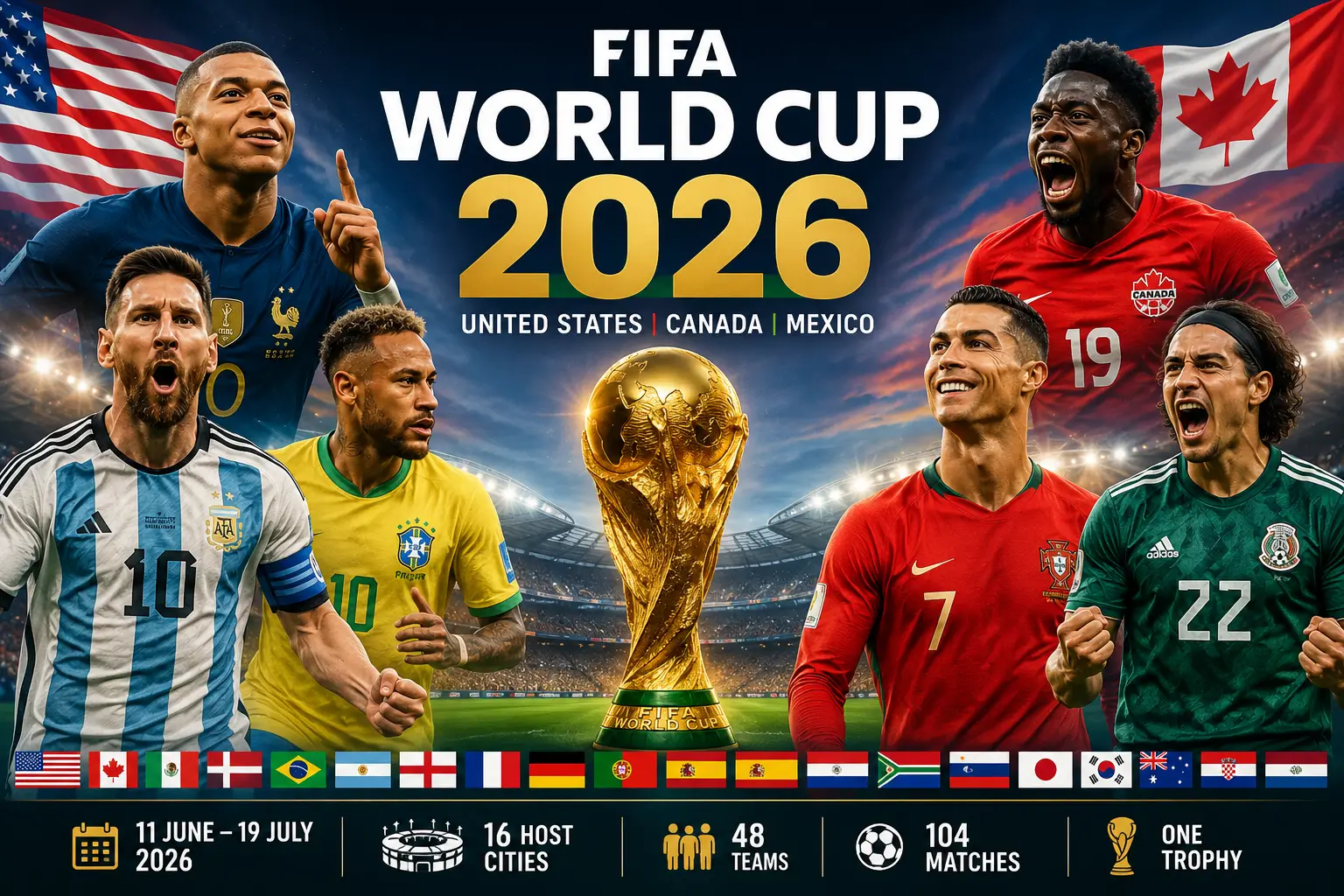
FIFA World Cup 2026: Full Guide to Teams, Scores & Schedule
There’s a moment during every World Cup when the tournament stops being background noise and becomes the only thing anyone at the office is talking about. For the 2026 edition, that moment arrived early and hasn’t let up since. By the time the Round of 32 wrapped up on July 3, we’d already watched Germany get eliminated on penalties by Paraguay, the Netherlands go home to Morocco in a shootout of their own, and Lionel Messi — at 38 years old, in what’s almost certainly his final World Cup — become the tournament’s all-time leading goalscorer.
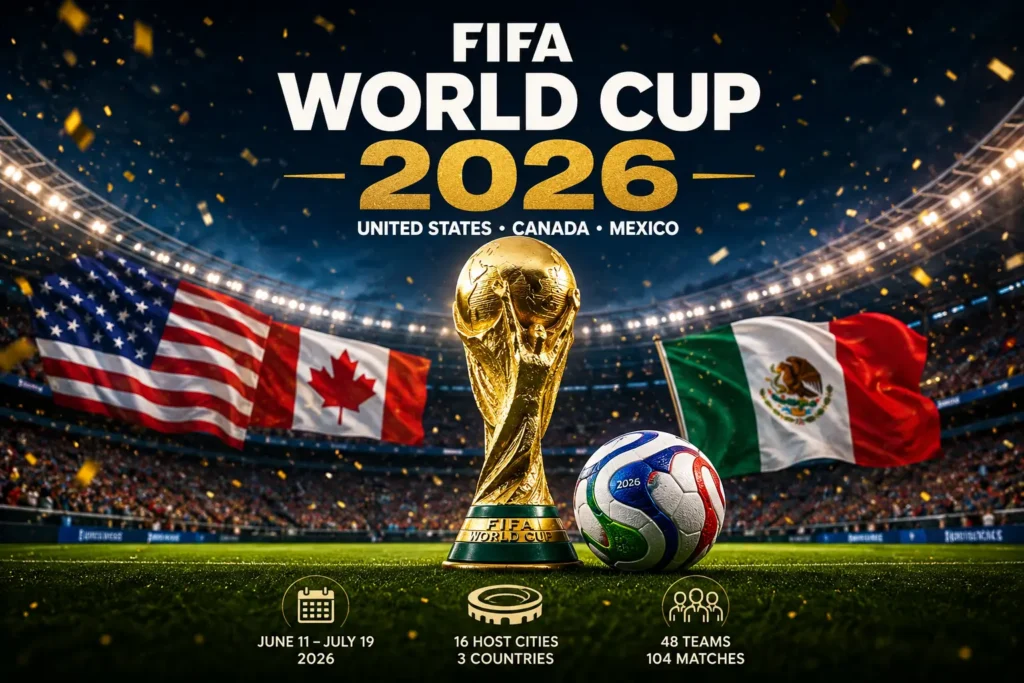
This is the FIFA World Cup 2026, and by nearly every measure that matters, it’s the biggest one there’s ever been. Forty-eight teams instead of 32. Sixteen stadiums spread across three countries instead of one. A prize pool that broke $871 million. And a format so different from what longtime fans grew up watching that even people who’ve followed every World Cup since Italia ’90 have needed a minute to get their bearings.
This guide exists to be the one page you actually need — whether you’re trying to understand how on earth a “Round of 32” works, whether you want the full rundown on who’s hosting matches where, or whether you just want to know if Messi can actually catch Kylian Mbappé in the Golden Boot race before the final whistle blows on July 19.
Key Takeaways
Why This World Cup Is Different From Every One Before It
Every World Cup gets called “historic” by somebody, usually before a ball’s even been kicked. This time the label actually holds up under scrutiny, and it’s worth being specific about why.
First, there’s the three-country hosting arrangement. The United States, Mexico, and Canada were jointly awarded the tournament back in 2018 under the “United 2026” bid, beating a rival bid from Morocco. No World Cup had ever been split across three nations before. Mexico, remarkably, becomes the first country in history to host or co-host the tournament three separate times, having previously done it in 1970 and 1986. The United States returns as host for the first time since the famous summer of 1994. For Canada, this is a first appearance as a World Cup host altogether.
Second, there’s the format itself, which we’ll break down in detail below — but the short version is that FIFA didn’t just add more teams to the existing structure. It rebuilt the middle of the tournament from scratch, adding an entirely new knockout round that simply didn’t exist in any prior World Cup.
Third, there’s the money. A $871 million prize pool isn’t just bigger than 2022’s $440 million — it’s a 65% increase in a single four-year cycle, reflecting both the expanded field and a surge in commercial and broadcast revenue that FIFA itself projects will exceed $6 billion in total tournament revenue, with media rights alone worth more than $3.8 billion globally.
And fourth, there’s simply the scale of it as a live event. Extending the tournament to 104 matches across 16 stadiums means this World Cup runs five and a half weeks instead of four, giving every host city, broadcaster, and fan considerably more time inside the bubble of the world’s biggest sporting event.
Did You Know? Four nations are competing in a men’s World Cup for the very first time in 2026: Cape Verde, Curaçao, Jordan, and Uzbekistan. None advanced deep into the knockout stage, but their mere presence reflects exactly what FIFA said it wanted when it approved the 48-team expansion — broader global representation on football’s biggest stage.
The New 48-Team Format, Explained Properly
This is the section worth reading twice if you’ve found the bracket confusing, because the confusion is legitimate — the structure genuinely changed, not just the team count.
How it used to work (1998–2022): 32 teams, eight groups of four, top two from each group advance straight into a Round of 16. Clean, symmetrical, easy to follow.
How it works now:
- Twelve groups of four teams each. Every team plays three round-robin matches, one against each other team in its group.
- Standard group scoring applies — three points for a win, one for a draw, zero for a loss — with goal difference and goals scored used as tiebreakers, same as always.
- The top two finishers in each group advance automatically. That’s 24 of the 48 teams through immediately.
- The eight best third-place teams across all twelve groups also advance. This is the genuinely new wrinkle — a team can finish third in its group and still make the knockout stage if its record compares favorably to other third-place finishers across the whole tournament.
- Those 32 survivors enter a brand-new Round of 32, a knockout round that has never existed at a men’s World Cup before this one.
- From there, it’s the familiar ladder: Round of 16, quarterfinals, semifinals, third-place match, and the final.
FIFA’s stated reasoning for choosing this structure over the alternatives is worth knowing, because it wasn’t the only option on the table. An earlier proposal considered 16 groups of just three teams each — but a three-team group creates an obvious integrity problem: in the final round of group matches, one team sits idle while the other two play each other, opening the door to a result that conveniently suits both remaining sides. FIFA’s own materials describe the four-team, twelve-group format as one that “mitigates the risk of collusion and ensures that all teams play a minimum of three matches while providing balanced rest time,” which is corporate language for “we didn’t want a repeat of the sport’s uglier moments with dead-rubber match-fixing incentives.”
The practical result: 104 total matches versus 64 in the old format, a full extra knockout round, and a bracket that takes real concentration to follow for the first time in decades.
Group Stage → Knockout Stage, Step by Step
| Stage | Teams Involved | Format | 2026 Dates |
|---|---|---|---|
| Group Stage | 48 | 12 groups of 4, round-robin | June 11 – June 26 |
| Round of 32 | 32 | Single elimination | June 28 – July 3 |
| Round of 16 | 16 | Single elimination | July 4 – July 7 |
| Quarterfinals | 8 | Single elimination | July 9 – July 11 |
| Semifinals | 4 | Single elimination | July 14 – July 15 |
| Third-Place Match | 2 | Single match | July 18 |
| Final | 2 | Single match | July 19 |
Host Countries, Cities and Stadiums
Sixteen stadiums. Three countries. Every one of them chosen through a multi-year elimination process that started with dozens of candidate cities and ended with a very specific 16.
The Selection Process, Briefly
FIFA didn’t simply pick 16 cities and move on — it ran a genuine elimination bracket of its own. A first round of cuts removed nine venues and nine cities from contention. A second round eliminated nine more venues across six cities. Along the way, three venues — Soldier Field in Chicago, U.S. Bank Stadium in Minneapolis, and BC Place in Vancouver — actually dropped out over unresolved financial terms with FIFA, though BC Place and Vancouver later rejoined the process after Montreal withdrew in 2021 due to a lack of provincial funding support. The final 16 were announced on June 16, 2022.
Full Stadium List
| City | Stadium | Country | Region |
|---|---|---|---|
| Mexico City | Estadio Azteca | Mexico | Central |
| Guadalajara | Estadio Akron | Mexico | Central |
| Monterrey | Estadio BBVA | Mexico | Central |
| Toronto | BMO Field | Canada | Eastern |
| Vancouver | BC Place | Canada | Western |
| Atlanta | Mercedes-Benz Stadium | USA | Eastern |
| Boston | Gillette Stadium | USA | Eastern |
| Dallas | AT&T Stadium | USA | Central |
| Houston | NRG Stadium | USA | Central |
| Kansas City | Arrowhead Stadium | USA | Central |
| Los Angeles | SoFi Stadium | USA | Western |
| Miami | Hard Rock Stadium | USA | Eastern |
| New York/New Jersey | MetLife Stadium | USA | Eastern |
| Philadelphia | Lincoln Financial Field | USA | Eastern |
| San Francisco Bay Area | Levi’s Stadium | USA | Western |
| Seattle | Lumen Field | USA | Western |
Stadium Facts Worth Knowing
- AT&T Stadium (Dallas) hosts more matches than any other venue at this tournament — nine games, including a semifinal.
- Estadio Azteca (Mexico City) is hosting its third World Cup, an all-time record no other stadium can match, having also staged the 1970 and 1986 finals.
- MetLife Stadium (New York/New Jersey) hosts the final on July 19, with a listed capacity of roughly 82,500.
- SoFi Stadium (Los Angeles), which opened in 2020 at a reported cost around $5 billion, will also host the opening and closing ceremonies of the 2028 Summer Olympics.
- Four venues — Atlanta, Dallas, Houston, and Vancouver — are fully enclosed with retractable roofs, giving organizers climate control regardless of outside conditions.
- Los Angeles has a translucent roof but no climate control, meaning the open-air heat and weather still factor in there.
- Pitches alternate between a hybrid Kentucky bluegrass/perennial ryegrass blend for cooler-climate cities and Bermuda grass for the hottest venues, a groundskeeping detail that’s mattered enormously given how brutal a North American summer afternoon can get for outfield players.
Expert Note: Heat management has been one of the quieter storylines of this tournament. Several European sides have publicly discussed altering training schedules and hydration protocols specifically to cope with conditions in the hottest host cities, and FIFA itself introduced mandatory hydration breaks in matches played under extreme heat — a rule most casual fans have never had to think about before this summer.
Group Stage Recap: What Actually Happened
The group stage ran from June 11 through June 26, and if you stepped away from the tournament for those two and a half weeks, here’s the condensed version of what you missed.
The hosts all delivered. The United States closed group play with a win over Bosnia and Herzegovina, Canada topped South Africa, and Mexico dispatched Ecuador — all three co-hosts advanced, which wasn’t a foregone conclusion given how untested Canada in particular was on this stage. Mexico in particular looked sharp throughout, winning Group A with maximum points behind contributions from forward Julián Quiñones.
Argentina rolled, and Messi made history. The defending champions cruised through their group, and Messi individually had a group stage for the ages — a hat-trick against Algeria in Kansas City, a brace against Austria, and a free-kick off the bench against Jordan. That run took him to 19 career World Cup goals, moving him past Germany’s Miroslav Klose to become the tournament’s all-time leading scorer.
Spain looked like the most complete team in the draw. Built around a blend of experienced core players and 18-year-old sensation Lamine Yamal — who scored his first World Cup goal in dramatic fashion — Spain entered the knockout rounds having topped several major outlets’ pre-tournament power rankings and done nothing since to dispel that reputation.
Brazil, Norway, and France all made statements. Vinícius Júnior scored in Brazil’s opener against Morocco and again in a 3-0 win over Haiti. Erling Haaland began his first-ever World Cup with goals in Norway’s group, including a strike against Ivory Coast. Ousmane Dembélé, the reigning Ballon d’Or winner, put together a first-half hat-trick against Norway that thrust him into the top tier of the Golden Boot conversation almost overnight.
Germany’s group stage included a statement win — and a stunning warning sign. The four-time champions demolished Curaçao 7-1, with Kai Havertz scoring twice, but their form proved fragile: a group stage that included that emphatic scoreline also set up a Round of 32 exit that nobody saw coming (more on that shortly).
Full Group Stage Standings Snapshot
| Group | Winner | Runner-Up | Notable Third Place |
|---|---|---|---|
| A | Mexico | South Korea | Czechia |
| B | Canada | Switzerland | Bosnia and Herzegovina |
| C | Brazil | Scotland | Morocco |
| D | United States | Paraguay | Australia |
| E | Germany | Ivory Coast | Ecuador |
| F | Netherlands | Japan | Sweden |
| G | Belgium | Iran | Egypt |
| H | Spain | Uruguay | Saudi Arabia |
| I | France | Norway | Senegal |
| J | Argentina | Austria | Jordan |
| K | Portugal | Colombia | Congo DR |
| L | England | Croatia | Ghana |
(Group assignments and standings reflect confirmed results through June 26–27, per widely reported group-stage coverage.)
Round of 32: The New Round, and Its Chaos
This is the round that didn’t exist in any World Cup before this one, and it delivered exactly the kind of unpredictability you’d expect from a brand-new format absorbing 16 extra teams that would previously have gone home after the group stage.
The headline results:
- Morocco eliminated the Netherlands on penalties, 3-2 in the shootout after a 1-1 draw — a genuinely stunning result against a team many had pegged for a quarterfinal run.
- Paraguay knocked out four-time champions Germany, also on penalties, 4-3 after a 1-1 draw. For a nation with Germany’s World Cup pedigree, an exit this early — on penalties, to a side many casual fans couldn’t have placed on a map before this tournament — ranks among the biggest shocks of the competition so far.
- Belgium came from behind to beat Senegal 3-2 in extra time, one of the most dramatic single matches of the round.
- England needed a second-half surge to beat DR Congo 2-1, with Harry Kane’s brace doing the damage after Yoane Wissa had given DR Congo hope.
- Switzerland completed a perfect run through the group stage and into the Round of 16 with a win over Algeria, a genuinely historic achievement for Swiss football that’s been one of the tournament’s quieter, more impressive storylines.
- Spain handled Austria comfortably, 3-0, continuing to look like the tournament’s most balanced side.
- Portugal survived Croatia 2-1 in a match that reopened the recurring debate about whether Cristiano Ronaldo, at 41, should still be an automatic starter.
- All three co-hosts advanced, with the USMNT beating Bosnia and Herzegovina 2-0, Canada beating South Africa, and Mexico beating Ecuador 2-0.
Fan Perspective: If you’ve been half-following this tournament and only catching highlights, the two results worth actually watching in full are Belgium–Senegal and Morocco–Netherlands. Both matches captured something the expanded format seems to be delivering more of than previous tournaments — genuine late-stage unpredictability from sides that wouldn’t have even been in the knockout mix under the old 32-team system.
Round of 16: Where the Tournament Stands Right Now
As of July 3, 2026, the Round of 16 is the stage currently being contested, running July 4 through July 7. Here’s the confirmed bracket:
| Date | Matchup | Venue |
|---|---|---|
| July 4 | Canada vs. Morocco | NRG Stadium, Houston |
| July 4 | France vs. Paraguay | Lincoln Financial Field, Philadelphia |
| July 5 | Brazil vs. Norway | MetLife Stadium, New Jersey |
| July 5 | Mexico vs. England | Estadio Azteca, Mexico City |
| July 6 | Spain vs. Portugal/Croatia winner | AT&T Stadium, Dallas |
| July 6 | Belgium vs. USMNT | Lumen Field, Seattle |
| July 7 | Brazil/Norway winner vs. Mexico/England winner | Mercedes-Benz Stadium, Atlanta |
| July 7 | Switzerland/Algeria winner vs. Colombia/Ghana winner | BC Place, Vancouver |
A few storylines to watch as this round plays out. Mexico hosting England at the legendary Estadio Azteca is arguably the single most anticipated fixture of the round on pure atmosphere alone — few venues in world football carry the history and noise of the Azteca on a night like this. The USMNT drawing Belgium in Seattle represents the toughest remaining test for any of the three co-hosts; Belgium’s extra-time win over Senegal in the previous round showed a team capable of grinding out results against elite opposition, and a USMNT win here would be the clearest signal yet that this generation of American players genuinely belongs deep in a World Cup bracket. And Spain facing the Portugal/Croatia survivor sets up a potential blockbuster in Dallas, pitting the tournament’s most in-form side against a Portugal team still carrying the Ronaldo question into every match.
What’s Left on the Calendar
| Stage | Dates | Venues |
|---|---|---|
| Quarterfinals | July 9 – 11 | Gillette Stadium (Boston), SoFi Stadium (Inglewood), Hard Rock Stadium (Miami), plus a fourth confirmed venue |
| Semifinals | July 14 – 15 | AT&T Stadium (Dallas), Mercedes-Benz Stadium (Atlanta) |
| Third-Place Match | July 18 | Hard Rock Stadium, Miami Gardens |
| Final | July 19, 3:00 PM ET | MetLife Stadium, East Rutherford, New Jersey |
The final’s kickoff time translates to 8:00 PM in London and 9:00 PM across most of Central Europe — worth noting now if you’re planning a watch party on the other side of the Atlantic. And in a genuine first for the tournament, the final will feature what’s being billed as the first Super Bowl-style halftime show in World Cup history, produced by Global Citizen and curated by Chris Martin of Coldplay, with performances reportedly featuring Madonna, Shakira, and BTS.
Prize Money: How the Record $871 Million Actually Breaks Down
FIFA didn’t just expand the field for 2026 — it dramatically expanded the money attached to it. The total financial distribution sits at $871 million, a roughly 65% increase over the $440 million paid out at Qatar 2022, and comfortably the largest prize pool in the sport’s history.
Prize Money by Finish
| Finish | Payout |
|---|---|
| Champion | $50 million (performance-based); total package exceeds $63.5 million with prep and qualification funding |
| Runner-up | $33 million |
| Third place | $29 million |
| Fourth place | $27 million |
| Every qualified team (guaranteed minimum) | At least $12.5 million, win or lose |
That guaranteed minimum splits into two pieces: a preparation payment, raised this cycle to $2.5 million from $1.5 million previously, and a qualification payment, now $10 million, up from $9 million. In practical terms, every one of the 48 federations walks away from this tournament with a substantial payday even after a first-round exit — a deliberate FIFA decision aimed at supporting smaller footballing nations’ development long-term.
It’s also worth being precise about where this money actually goes. Prize money is paid to national federations, not directly to individual players. Each federation negotiates its own arrangement with its players and coaching staff, and the typical player share tends to land somewhere between 20% and 30% of the total payout, split across the entire traveling squad.
Prize Money Growth Over Time
| Year | Champion’s Prize | Total Prize Pool |
|---|---|---|
| 1982 | $2.2 million | — |
| 2002 | $9 million | — |
| 2006 | $20 million | — |
| 2022 | $42 million | $440 million |
| 2026 | $50 million | $871 million |
The 2022-to-2026 jump of $8 million for the champion is the largest single-tournament dollar increase in the award’s history.
Players to Watch: The Storylines Carrying This Tournament
The Icons Playing Their Final Act
Lionel Messi, now 38 and playing what’s widely believed to be his sixth and final World Cup, has already rewritten the record books this summer. His hat-trick against Algeria, brace against Austria, and late free-kick against Jordan pushed his career World Cup goal tally to 19, passing Miroslav Klose to become the competition’s all-time leading scorer — a record that had stood since 2014. Whether he can add a second World Cup title to go with his 2022 triumph in Qatar is the single biggest storyline of the tournament’s second half.
Cristiano Ronaldo, at 41, is playing in his sixth World Cup for Portugal, and the debate that’s followed him through the group stage and Round of 32 hasn’t gone away: is he still Portugal’s best option up front, or has the team’s ceiling become higher with him coming off the bench? Portugal’s narrow 2-1 win over Croatia did little to settle the argument either way.
The Breakout Star
Lamine Yamal, still a teenager, has been one of the genuine revelations of the tournament for Spain — scoring his first-ever World Cup goal in dramatic fashion in his own hometown and looking every bit like the face of the sport’s next generation. If Spain goes deep, Yamal’s tournament will be remembered as the moment he arrived fully on football’s biggest stage.
The Host Nation Hopes
For the United States, Christian Pulisic remains the squad’s talisman, though a handful of rest days through the group stage sparked genuine debate about squad rotation versus maintaining momentum. Folarin Balogun has been arguably the USMNT’s standout performer, scoring in the group stage and drawing reported interest from major European clubs off the back of his tournament form. Giovanni Reyna produced one of the group stage’s most memorable individual moments, scoring twice in a lopsided win over Paraguay.
Golden Boot Race
The race for the adidas Golden Boot — awarded to the tournament’s top scorer — has been one of the tightest and most closely tracked storylines of the summer. As of July 2–3, here’s where it stands:
| Player | Country | Goals | Notes |
|---|---|---|---|
| Kylian Mbappé | France | 6 | Level with Messi; ahead on the assists tiebreaker |
| Lionel Messi | Argentina | 6 | Now the all-time World Cup leading scorer (19 career goals) |
| Erling Haaland | Norway | 5 | Scored the winner that eliminated Ivory Coast |
| Harry Kane | England | 5 | Brace against DR Congo in the Round of 32 |
| Vinícius Júnior | Brazil | 4 | One assist also in the mix as a tiebreaker |
| Ousmane Dembélé | France | 4 | First-half hat-trick against Norway in the group stage |
| Ismaïla Sarr | Senegal | 4 | Eliminated in the Round of 32, but stays on the leaderboard |
How ties are broken: if two or more players finish level on goals, FIFA applies three tiebreakers in order — fewest matches played, then most assists, then fewest total minutes on the pitch. If everything is still equal, the award is shared. No player has ever won the Golden Boot more than once, a reminder of just how difficult it is to dominate goalscoring charts across two separate tournaments four years apart.
Did You Know? Just Fontaine’s 13 goals for France at the 1958 World Cup remains the all-time single-tournament scoring record and has stood for nearly 70 years. With eight possible matches available to any finalist in 2026 (compared to seven in the old 32-team format), it’s the best structural chance any player has had in decades to seriously challenge it — though 7-10 goals is still the realistic range needed to win the Golden Boot outright in a stacked field like this one.
Golden Glove Watch
The Golden Glove, awarded to the tournament’s best goalkeeper, typically comes down to a mix of clean sheets, save percentage, and how deep a keeper’s team advances — meaning the real race won’t sharpen into focus until the semifinal picture is set. Goalkeepers from Spain, France, Argentina, and both host nations still alive in the bracket remain in realistic contention heading into the Round of 16.
The Rules Every Casual Fan Should Actually Understand
If you’re the person at the watch party who needs the rules explained without the condescension, here’s the honest, no-jargon version.
Offside, simply: An attacking player can’t be nearer to the opponent’s goal line than the second-last defender (usually, but not always, the last outfield defender) at the moment the ball is played to them — unless they’re in their own half. It’s judged at the exact instant the pass is made, not when the player receives it, which is why VAR reviews on offside calls can look so painstaking on replay.
VAR (Video Assistant Referee): A team of officials watching the match on video feeds who can flag the referee to review specific situations — goals, penalty decisions, straight red cards, and cases of mistaken identity. It doesn’t review every decision; it exists specifically to catch “clear and obvious” errors on those four categories.
Extra time: If a knockout match is level after 90 minutes plus stoppage time, two additional 15-minute periods are played, for a maximum of 120 minutes total.
Penalty shootout: If the score is still tied after extra time, the match moves to penalties. Each team takes alternating kicks from the penalty spot, initially five each, with the shootout continuing in sudden-death rounds if still tied after that.
Group stage tiebreakers: Points first, then goal difference, then goals scored, then head-to-head result, with additional criteria like disciplinary record and, if necessary, a drawing of lots as an absolute last resort.
World Cup History: The Records This Tournament Is Chasing
Even after the trophy is lifted on July 19, the story of the 2026 World Cup becomes part of a history that stretches back to Uruguay in 1930, when just 13 teams competed. It’s worth knowing where 2026 fits into that bigger picture.
Tournament Growth Over Time
| Era | Team Count | Years |
|---|---|---|
| Founding era | 13 teams | 1930 |
| Post-war expansion | 16 teams | 1934–1978 (with variation) |
| Modern era begins | 24 teams | 1982–1994 |
| Long-standing standard | 32 teams | 1998–2022 |
| Current era | 48 teams | 2026–present |
Most World Cup Titles (All-Time, Entering 2026)
| Country | Titles |
|---|---|
| Brazil | 5 |
| Germany | 4 |
| Italy | 4 |
| Argentina | 3 |
| France | 2 |
| Uruguay | 2 |
| England | 1 |
| Spain | 1 |
Argentina arrived in North America as the reigning champion, having won the 2022 tournament in Qatar under Messi’s captaincy — a title that instantly reframed his career legacy and set up the emotional weight around this potentially final World Cup appearance.
Records Worth Knowing
- Highest single-match attendance: the 1950 World Cup final at Brazil’s Maracanã Stadium, officially recorded at 173,850 spectators, with some historical estimates running even higher.
- Most matches hosted by a single stadium: Estadio Azteca, now standing alone at the top after its third World Cup in 2026.
- All-time leading World Cup goalscorer: Lionel Messi, having passed Miroslav Klose’s long-standing record of 16 during this tournament’s group stage.
- Single-tournament scoring record: Just Fontaine, 13 goals for France in 1958 — still unmatched nearly seven decades later.
Favorites, Dark Horses, and the Biggest Disappointments
Every World Cup produces its own version of this conversation, and 2026 is no exception — except with 48 teams instead of 32, there’s simply more room for both brilliance and heartbreak to play out simultaneously.
The Favorites
Spain enters the knockout rounds’ second half as the consensus pick among neutral observers, and it’s not hard to see why. The squad combines proven winners from Spain’s recent European success with a teenage phenomenon in Lamine Yamal who’s already scoring in front of his own hometown crowd. Their 3-0 dismantling of Austria in the Round of 32 was as much a statement as a result. Argentina, as defending champion, carries the obvious weight of recent knockout-football experience, and Messi’s individual form has been so strong through the group stage that it’s dragged the entire team’s ceiling upward. France, even without the same generational dominance of their 2018 title run, still boasts Mbappé in career-best scoring form and enough depth to trouble anyone left in the bracket.
The Dark Horses
Switzerland’s run has quietly become one of the tournament’s most compelling stories — a team that finished its group stage unbeaten and then handled Algeria in the Round of 32 to reach the Round of 16 for what pundits are calling one of the great runs in modern Swiss football history. Morocco, fresh off eliminating the Netherlands on penalties, has shown the kind of knockout-round composure that took the country all the way to the semifinals of the 2022 tournament in Qatar — and there’s a real argument that this squad, with more tournament experience now baked in, could match or exceed that run. Colombia, powered by contributions from veteran playmaker James Rodríguez and a deep pool of attacking talent, has flown somewhat under the radar compared to the traditional powers but remains alive heading into the back half of the Round of 16 fixtures.
The Biggest Disappointments
Germany’s exit stings the most among the traditional powers — a four-time champion, eliminated in a brand-new knockout round against Paraguay, on penalties, despite having demolished Curaçao 7-1 just days earlier in the group stage. It’s the kind of result that will trigger a genuine reckoning back home about squad depth and tactical rigidity in single-elimination football. The Netherlands’ exit to Morocco carries a similar sting — a team many pundits had pegged for at least a quarterfinal appearance, gone in the first new knockout round, on penalties, to a side playing with visibly more knockout-stage composure. Beyond the two co-favorites who went home early, several traditionally strong footballing nations found the expanded 48-team group stage tougher than expected simply because it meant facing a wider spread of genuinely dangerous opposition earlier in the tournament than the old 32-team bracket ever required.
The Story of the Debut Nations
It’s worth pausing on Cape Verde, Curaçao, Jordan, and Uzbekistan specifically, because their presence is arguably the most concrete proof that FIFA’s 48-team gamble is paying off exactly as intended. None of the four advanced deep into the knockout stage — but that was never really the point in year one. Cape Verde, a nation of roughly 500,000 people, played Argentina on the World Cup’s biggest stage and gave Messi’s side a genuine contest rather than a formality. Jordan competed directly against Argentina in the group stage as well, marking the country’s first-ever men’s World Cup appearance after decades of near-misses in Asian qualifying. Uzbekistan and Curaçao both made their tournament debuts too, each carrying real symbolic weight for football development programs that had spent years building toward exactly this moment.
The financial side matters here too: every one of these four debutant nations is guaranteed at least $12.5 million in FIFA prize money regardless of result, money that federation officials in each country have already discussed reinvesting directly into youth development and domestic league infrastructure. That’s the quieter, longer-term legacy of the 48-team expansion — not just more matches this summer, but a wider base of national federations with both World Cup experience and meaningful new revenue to build on for the next cycle.
Messi vs. Ronaldo: A World Cup Career Comparison
With both players almost certainly playing their final World Cup in 2026, the comparison has taken on real emotional weight this summer. Here’s how their tournament careers stack up heading into the knockout rounds.
| Category | Lionel Messi | Cristiano Ronaldo |
|---|---|---|
| World Cups played | 6 (2006–2026) | 6 (2006–2026) |
| Career World Cup goals | 19 (all-time record) | Fewer than Messi, but still among the tournament’s active scoring leaders |
| World Cup titles won | 1 (2022) | 0 |
| Golden Ball wins | 2 (2014, 2022) | 0 |
| Age entering 2026 tournament | 38 | 41 |
| 2026 tournament role | Talisman and captain, Argentina | Veteran forward, frequent subject of starting-lineup debate |
Neither player has ever won the Golden Boot outright across six tournaments each, which says something about just how difficult that individual honor is to claim even for two of the greatest goalscorers the sport has ever produced. What Messi has that Ronaldo doesn’t is the trophy itself — and a shot, this summer, at becoming just the third man in history to lift it twice.
Full Tournament Timeline
| Date | Milestone |
|---|---|
| June 11, 2026 | Opening match: Mexico vs. South Africa, Estadio Azteca |
| June 12, 2026 | Canada and United States both play their opening matches |
| June 11 – 26, 2026 | Group stage, all 48 teams, 12 groups |
| June 28 – July 3, 2026 | Round of 32 (new knockout round) |
| July 4 – 7, 2026 | Round of 16 |
| July 9 – 11, 2026 | Quarterfinals |
| July 14 – 15, 2026 | Semifinals |
| July 18, 2026 | Third-place match, Miami Gardens |
| July 19, 2026 | Final, MetLife Stadium, 3:00 PM ET |
A Few of the Greatest World Cup Finals Ever Played
Worth knowing regardless of how 2026 ends, if only because it puts whatever happens at MetLife Stadium in proper historical context. The 1970 final, played at this same Estadio Azteca now hosting matches again in 2026, is still regularly cited by historians as the high-water mark of attacking football, with Pelé’s Brazil producing one of the sport’s most celebrated single-team performances. The 1986 final, also at the Azteca, closed out Diego Maradona’s singular individual tournament for Argentina. More recently, the 2014 final between Germany and Argentina and the 2022 final between Argentina and France — the latter widely regarded as one of the greatest matches in the sport’s history, decided on penalties after a stunning Mbappé hat-trick for France was matched by Messi’s own heroics for Argentina — set an extraordinarily high bar for whatever unfolds on July 19 this year.
Economic Impact and Fan Culture
Hosting a World Cup is never just a sporting decision — it’s an infrastructure and tourism bet that plays out over years, not weeks. Host cities across the U.S., Mexico, and Canada spent years ahead of 2026 upgrading stadiums, transit systems, and hospitality infrastructure specifically for this tournament. Dallas alone committed roughly $15 million just to serve as a media hub, hosting FIFA’s International Broadcast Centre for the entire event. Multiply that kind of investment across 16 host cities and three countries, and the scale of the economic footprint becomes clear — this is as much a month-long infrastructure showcase as it is a sporting event.
The fan culture side has been just as striking. FIFA has confirmed broadcast deals in more than 175 territories worldwide, with the final holdout markets — including India, Pakistan, China, and Bangladesh — signing agreements in the weeks before kickoff. Brazil is streaming every single match free via CazéTV on YouTube. The UK gets every match free between the BBC and ITV. It’s genuinely difficult to find a country left out of at least some form of free-to-air or accessible streaming coverage, which is a meaningful part of why FIFA projects a global audience in the billions across the tournament’s five-and-a-half-week run.
How to Watch: TV, Streaming and Ticket Guide
United States Broadcast Coverage
| Language | Networks | Streaming |
|---|---|---|
| English | Fox, FS1 | Fox One ($19.99–$20/month) |
| Spanish | Telemundo (92 matches), Universo (12 matches) | Peacock Premium ($10.99–$11/month) |
All 104 matches are available across Fox’s English-language coverage and Telemundo/Universo’s Spanish-language coverage combined — meaning every match in the tournament is watchable in the U.S. between the two networks. Fox has also experimented with new viewing formats this cycle, partnering with immersive-venue company Cosm to show roughly 40 matches — including the opening match, every USMNT game, and the final — in a shared-reality format at select locations.
International Coverage Snapshot
| Region | Primary Broadcasters |
|---|---|
| United Kingdom | BBC and ITV (free) |
| Canada | CTV (free), TSN, RDS |
| Mexico | TelevisaUnivision, TV Azteca (free) |
| Australia | SBS (free) |
| Brazil | Grupo Globo, CazéTV on YouTube (free) |
| Germany | ARD/ZDF (select matches, free), MagentaTV (all matches) |
| France | M6 (54 matches, free), beIN Sports (remainder) |
| MENA region | beIN Sports (24 countries) |
| India | Zee Entertainment |
| China | CMG/CCTV, Migu |
Tickets and Travel
Ticket demand for this tournament has been extraordinary, and pricing has followed — even lower-tier seats at group-stage matches have reportedly run into the hundreds of dollars, with knockout-round and final tickets reaching considerably higher through official FIFA channels and authorized resale partners. If you’re planning to attend a match in person during the remaining knockout rounds, book official tickets and travel only through FIFA’s own sales channels or explicitly FIFA-authorized partners — the tournament’s scale has also made it a magnet for resale scams, and there’s no reliable secondary-market guarantee once you’re outside official channels.
How Teams Actually Qualify: A Confederation-by-Confederation Primer
One question that comes up constantly from newer fans: how do 48 teams even get selected in the first place? The answer runs through six separate continental confederations, each running its own multi-year qualifying competition with a fixed number of guaranteed World Cup slots, plus a handful of intercontinental playoff spots for the teams that fall just short of automatic qualification.
- UEFA (Europe) runs the largest and generally most competitive qualifying bracket, given the sheer number of strong footballing nations packed into the continent.
- CONMEBOL (South America) qualifies its teams through a single grueling round-robin among all ten member nations, a format widely regarded as one of the toughest qualifying gauntlets in world football.
- CONCACAF (North/Central America and the Caribbean) benefited significantly from the expanded 2026 field, with automatic host-nation berths for the U.S., Mexico, and Canada freeing up additional qualifying slots for the rest of the region.
- CAF (Africa) and AFC (Asia) both saw meaningfully expanded slot counts under the 48-team format, part of why debut nations like Jordan and Uzbekistan were able to break through this cycle.
- OFC (Oceania) retains a small guaranteed allocation, supplemented by intercontinental playoff opportunities.
A handful of the final spots across the world are decided through intercontinental playoff tournaments, bringing together near-miss qualifiers from different confederations for a last-chance shot at the 48-team field. It’s a format that’s produced some of the most dramatic non-World-Cup football of the entire four-year cycle, precisely because so much is riding on a single match or short knockout series.
The Future of the World Cup
However the 2026 knockout rounds resolve themselves, this tournament has already set the template for what comes next. The 48-team format isn’t a one-off experiment — it’s now the standard going forward, meaning future host nations will need to plan for the same scale of stadium infrastructure, broadcast logistics, and prize-money distribution that the United States, Mexico, and Canada have spent years building toward. The revenue numbers alone make a reversal to a smaller field almost unthinkable: with FIFA projecting roughly $6 billion in total tournament revenue and media rights alone exceeding $3.8 billion globally, the financial incentive to keep growing the event is enormous.
What’s less certain is how the sport adapts to the scheduling and player-welfare questions a 104-match, five-and-a-half-week tournament raises. Several federations and player unions have already flagged concerns about fixture congestion given how packed the modern club football calendar has become, and those conversations are likely to intensify regardless of how well this specific tournament is remembered. For now, though, the immediate story is simpler: sixteen teams are left, two and a half weeks of football remain, and a genuinely global sport is about to find out who its next champion is.
Fantasy Football and Prediction Corner
For fans running a fantasy World Cup pool through the remaining rounds, a few practical notes worth weighing heading into the Round of 16: goalkeepers on teams still facing at least two more knockout matches (Spain, France, Argentina, and the surviving host nations) carry real clean-sheet upside given how tight knockout football tends to get. On the attacking side, Mbappé and Messi’s tie atop the Golden Boot race makes them the two highest-value scoring assets remaining, but Haaland’s underlying chance-creation numbers through the group stage suggest he’s arguably the best value pick if you need a differentiator from the two most obvious names.
Predictions (Clearly Labeled as Opinion)
Everything below is analysis and opinion, not certainty — the honest way to frame any prediction with real knockout football still to be played.
Spain enters the second half of this tournament looking like the most complete side left standing: continuity from recent European success, a genuine world-class talent in Yamal, and squad depth that’s held up better than most of the traditional powers through both the group stage and Round of 32. Argentina, even with Messi turning 39 mid-tournament, remains dangerous purely on the strength of knowing how to win knockout football — that kind of recent title-winning experience is difficult to manufacture and even harder to replicate under pressure. France and England both have the individual talent to go all the way but have looked less tactically settled than Spain through the tournament’s first two stages. And if a host nation is going to make a genuine surprise run deep into July, the USMNT’s Round of 16 test against Belgium is the real litmus test — beating a European side with Belgium’s knockout pedigree would be the clearest signal yet that this generation of American players belongs on the sport’s biggest stage.
Frequently Asked Questions
How many teams are competing in the FIFA World Cup 2026?
Forty-eight, up from 32 in every prior tournament since 1998.
How many total matches are being played?
104, compared with 64 under the old format.
When is the World Cup 2026 final, and where?
Sunday, July 19, 2026, at MetLife Stadium in East Rutherford, New Jersey, kicking off at 3:00 PM ET.
Which countries are hosting the tournament?
The United States, Mexico, and Canada — the first three-nation World Cup in history.
How does the new format actually work?
Twelve groups of four teams each, with the top two from every group plus the eight best third-place teams advancing to a newly created Round of 32, before proceeding into the familiar Round of 16, quarterfinals, semifinals, and final.
How much prize money is FIFA distributing this year?
A record $871 million total, with the champion earning $50 million in performance-based money alone, and a total package exceeding $63.5 million once preparation and qualification funding is included.
What happens if a knockout match is tied after 90 minutes?
Two 15-minute periods of extra time are played; if the match is still level, it proceeds to a penalty shootout.
Is this Lionel Messi’s last World Cup?
It’s widely expected to be, given his age, though Messi himself has not made a definitive public declaration confirming that either way.
Who is leading the Golden Boot race?
As of the Round of 16, Kylian Mbappé and Lionel Messi are tied at six goals each, with Mbappé ahead on the assists tiebreaker; Erling Haaland and Harry Kane follow closely on five.
Which teams are making their World Cup debut in 2026?
Cape Verde, Curaçao, Jordan, and Uzbekistan.
Which stadium is hosting the most matches?
AT&T Stadium in Arlington (Dallas area), with nine matches including a semifinal.
Did all three host nations make the knockout stage?
Yes — the United States, Canada, and Mexico all advanced through the group stage and Round of 32 into the Round of 16.
What were the biggest upsets of the tournament so far?
Paraguay eliminating four-time champion Germany on penalties, and Morocco eliminating the Netherlands on penalties, both in the Round of 32.
How can I watch the World Cup in the United States?
English-language coverage airs across Fox and FS1, with streaming on Fox One; Spanish-language coverage airs on Telemundo and Universo, with streaming on Peacock Premium. Together, the two networks air all 104 matches.
What is the official match ball called?
The adidas TRIONDA.
Who are the official tournament mascots?
Maple the Moose (Canada), Zayu the Jaguar (Mexico), and Clutch the Bald Eagle (United States).
How is the Golden Boot winner determined if players are tied on goals?
FIFA applies three tiebreakers in order: fewest matches played, then most assists, then fewest total minutes played; if all three are equal, the award is shared.
Which country has won the most World Cups all-time?
Brazil, with five titles.
Who is the reigning champion entering this tournament?
Argentina, winners of the 2022 World Cup in Qatar.
What’s special about this year’s final?
It will feature the first Super Bowl-style halftime show in World Cup history, reportedly produced by Global Citizen and curated by Chris Martin of Coldplay.
Final Thoughts: What This World Cup Means Going Forward
Whatever happens between now and July 19, this tournament has already permanently reshaped what a World Cup looks like. It’s bigger, it pays out dramatically more to the nations that qualify, and it’s given a genuine stage — not a token appearance, but real matches against elite opposition — to countries that have historically watched the sport’s biggest month from the outside. Cape Verde, Curaçao, Jordan, and Uzbekistan didn’t just show up in 2026; they played real football against the sport’s traditional powers, and that alone is a structural shift that outlasts whoever ultimately lifts the trophy at MetLife Stadium.
For Messi, this tournament already carries a legacy-cementing achievement regardless of how the knockout rounds finish — the all-time World Cup scoring record is now his. For Ronaldo, it’s a final chapter still being written in real time. For the USMNT, Canada, and Mexico, simply reaching the Round of 16 as co-hosts represents a credible foundation heading into a knockout stretch where anything can happen.
And for the sport itself, the 48-team era is here to stay. However this specific tournament resolves itself over the next two and a half weeks, the format, the money, and the global reach on display in 2026 have already set the template every World Cup after it will be measured against.