AI Technology Highlights 2026: The Year of the Autonomous Agent
Introduction
In 2024, we talked to AI. In 2025, we integrated AI. But in 2026, AI is finally starting to act.
If you feel like the pace of change is accelerating, you aren’t alone. We have officially moved past the era of “innovation theater”—those flashy but hollow tech demos—and entered the “Year of Truth.” This is the year where technology stops being a tool on a screen and starts becoming a physical, autonomous presence in our offices, our warehouses, and our daily lives.
From the rise of Agentic AI that can manage your entire calendar without a single prompt to the “Physical AI” revolution in robotics, the tech landscape of 2026 is about one thing: Autonomy.
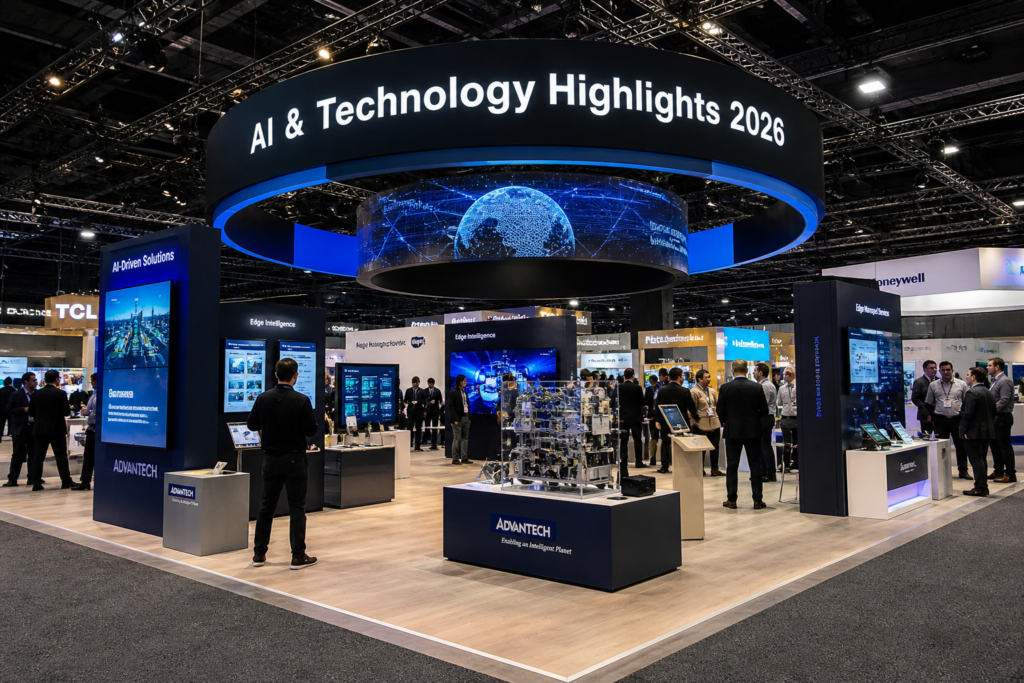
In this deep dive, we explore the AI & technology highlights 2026 that are reshaping the global economy. Whether you are a business leader, a developer, or a curious observer, these are the shifts you cannot afford to ignore.
1. The Rise of Agentic AI: From Chatbots to Digital Coworkers
The single biggest highlight of 2026 is the transition from Generative AI to Agentic AI.
For the past three years, Large Language Models (LLMs) were reactive. You gave a prompt; they gave a response. In 2026, the paradigm has shifted. AI “agents” now possess long-term memory, reasoning capabilities, and the authority to execute multi-step tasks across different software ecosystems.
Why Agents are the New Workforce
Unlike a chatbot, an agent doesn’t just write an email. It identifies a potential lead, researches their recent company filings, drafts a personalized proposal, and schedules a meeting in your calendar—all while you sleep.
Key 2026 milestones in Agentic AI:
- Self-Verification: Modern agents now have internal feedback loops. They “check” their own work before presenting it, drastically reducing the hallucinations that plagued early models.
- Interoperability: In 2026, we are seeing the emergence of standard protocols that allow different AI agents to “talk” to each other. Your personal agent can now negotiate directly with a vendor’s agent to get the best price on a subscription.
- English as a Programming Language: We’ve reached the point where “intent-driven development” is mainstream. Developers now articulate the logic in natural language, and AI agents build, test, and deploy the code autonomously.
2. Physical AI: Bringing Intelligence to the Real World
If 2023 was the year of the brain, 2026 is the year of the body. We are witnessing the convergence of high-level reasoning models with advanced robotics, often referred to as Physical AI.
Humanoid Robots in the Wild
Companies like Tesla, Figure, and Xiaomi have moved their humanoid robots out of the lab and into active duty. In 2026, these robots are no longer just walking in straight lines. They are performing “unstructured tasks”—jobs that require them to adapt to a messy, changing environment.
Where Physical AI is Hitting Hardest:
- Logistics & Warehousing: Autonomous “swarm” robots are coordinating in real-time to manage 100% of the sorting in major fulfillment centers.
- Healthcare: Surgical robots equipped with quantum sensors are performing procedures with 94% less nerve damage than traditional methods.
- Urban Design: Autonomous mobility has shifted from a novelty to a municipal utility. In cities like Shenzhen and Phoenix, driverless ride-hailing is now the primary mode of public transit.
3. Quantum Computing 2026: The “Hybrid” Inflection Point
For a long time, quantum computing was “five years away.” In 2026, it’s finally arrived in a “Hybrid” format.
We aren’t seeing massive, standalone quantum computers replacing our laptops yet. Instead, we are seeing Quantum-Classical Hybrid Infrastructure. Major cloud providers now offer “Quantum-as-a-Service,” where complex optimization problems (like global supply chain routing or molecular modeling) are offloaded to a quantum processor, while the rest of the app runs on traditional silicon.
Real-World Quantum Wins in 2026
- Cryptography: The “Post-Quantum Cryptography” (PQC) transition is in full swing. Financial institutions are racing to update their encryption before “Q-Day”—the hypothetical day a quantum computer can break current security.
- Energy Efficiency: Quantum-informed AI models are now being used to design new battery materials, specifically tandem perovskite solar cells, which have hit a record 34.85% efficiency this year.
4. The Infrastructure Crisis: Power, Water, and Space
While the software is getting smarter, the hardware is hitting a wall. One of the less-discussed but vital technology highlights of 2026 is the global data center bottleneck.
The demand for AI compute has outpaced our ability to build power grids. In many regions, data center vacancy is below 3%, and companies are waiting 24 months for the electricity needed to run their new clusters.
The New Computational Frontier: Space
To solve the heat and energy problems of Earth-based data centers, 2026 has seen the first successful deployment of “Orbiting Data Centers.” By leveraging the natural vacuum and cold of space, companies like Nvidia and StarCloud are beginning to train models in low Earth orbit, using direct solar power.
5. Cybersecurity in the Era of Preemptive Defense
As AI becomes more powerful, so do the threats. However, 2026 has introduced Preemptive Cybersecurity.
Security systems no longer wait for a breach to occur. They use “digital twins” of a company’s network to run millions of simulated attacks per hour. By identifying a vulnerability before a human or rogue AI can exploit it, these systems “patch” the network in real-time.
Key Security Shifts:
- Digital Provenance: With deepfakes becoming indistinguishable from reality, 2026 marks the mandatory adoption of digital watermarking for all AI-generated content.
- Confidential Computing: Data is now protected even while it is being processed, allowing competitors to collaborate on AI models without ever seeing each other’s raw, sensitive data.
6. Sustainable IT: The Carbon Budget Era
In 2026, “Greenwashing” is dead, and “Carbon-Aware Computing” is the law. Regulatory bodies, particularly in the EU, now require companies to report the exact carbon footprint of every AI training run.
Sustainable highlights include:
- Small Language Models (SLMs): The trend has shifted away from “bigger is better.” Highly specialized, small models that run on edge devices (like your phone) are replacing massive, energy-hungry general models for 80% of daily tasks.
- Sodium Batteries: A breakthrough in logistics, sodium-ion batteries are now powering autonomous truck fleets, offering a cheaper, more sustainable alternative to lithium.
7. The Future of Work: Managers of Machines
The most human-centric technology highlight of 2026 is the changing definition of a “career.”
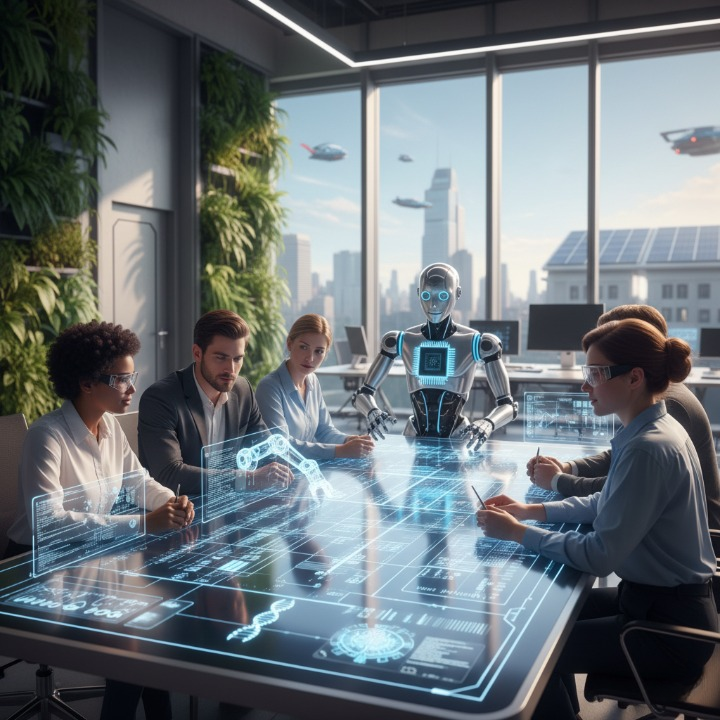
In 2026, you aren’t just an individual contributor; you are a Manager of Agents. Every professional, from accountants to graphic designers, now oversees a small “fleet” of AI agents. Success in the 2026 job market is less about how you do the work and more about how you delegate and audit the output of your digital subordinates.
(Frequently Asked Questions)
1. What is the biggest tech trend in 2026?
The biggest trend is Agentic AI. This refers to AI systems that don’t just generate text but can autonomously execute complex, multi-step tasks across various platforms with minimal human intervention.
2. Is AI replacing jobs in 2026?
AI is displacing tasks rather than entire jobs. While routine data entry and basic coding are largely automated, there is a massive surge in demand for “Human-AI Orchestrators”—people who can manage and audit AI agent workflows.
3. How is Quantum Computing being used today?
In 2026, it is primarily used in a hybrid capacity for complex simulations in drug discovery, financial risk modeling, and optimizing global logistics routes that are too complex for traditional computers.
4. What are “Physical AI” robots?
Physical AI refers to the integration of advanced AI brains into robotic bodies. Unlike old-school factory robots, these can learn through “trying and failing” in real-world environments, making them suitable for healthcare, delivery, and home assistance.
5. Why is there a data center crisis?
The sheer amount of electricity and water required to cool AI supercomputers has exceeded the capacity of many local power grids. This has led to a shift toward edge computing and even experimental space-based data centers.
Conclusion
The AI & technology highlights 2026 paint a clear picture: we are moving toward a world that is smarter, faster, and more autonomous. We have transitioned from the “Internet of Things” to the “Intelligence of Everything.”
For businesses, the message is clear: move from experimentation to integration. Focus on building a durable foundation of data and governance so your AI agents have the right environment to thrive. For individuals, the key skill is Digital Dexterity—the ability to pivot as new autonomous tools emerge.
The future isn’t man vs. machine; it’s man plus machine. And in 2026, that partnership is finally delivering on its promise.