Powerful Digital Marketing Trends You Must Know 2026
Introduction
What if you could unlock the exact Digital Marketing Trends that are driving millions of clicks, traffic, and sales right now?
Most websites fail—not because they lack effort, but because they follow outdated strategies that no longer work. Meanwhile, smart marketers are quietly using new trends to dominate Google rankings, go viral on social media, and build unstoppable online businesses.
Here’s the truth:
Digital marketing has changed completely. Algorithms are smarter, users are more selective, and competition is tougher than ever. If you’re not using the latest strategies, you’re already behind.
But don’t worry—you’re about to get ahead.
In this guide, you’ll discover the most powerful Digital Marketing Trends, real-world strategies, and proven techniques that can help you:
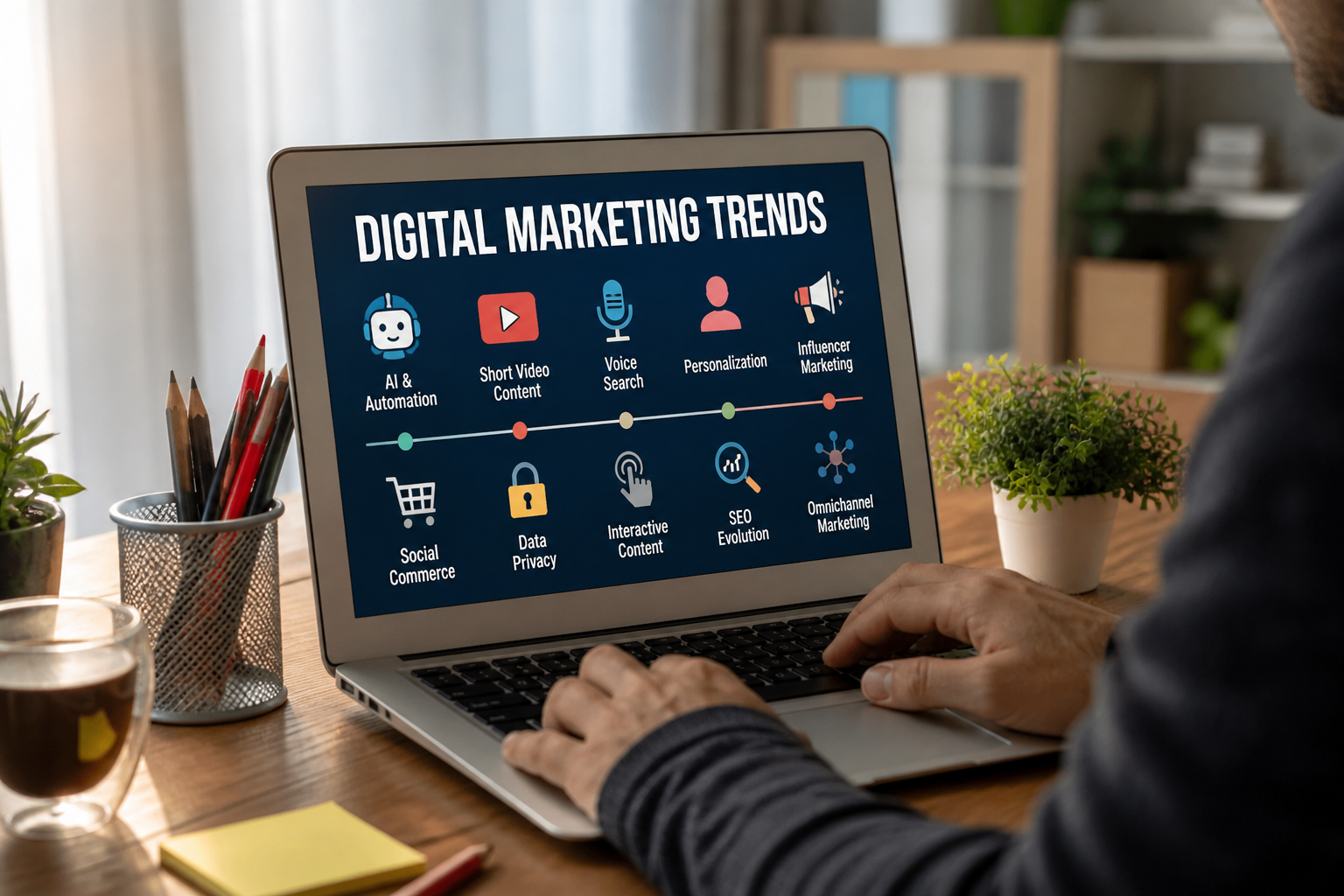
10 Massive Digital Marketing Trends That Will Dominate 2025
The digital landscape isn’t just changing; it’s undergoing a total transformation. If you feel like you’re constantly chasing an algorithm that moves faster than you can type, you aren’t alone. In 2025, “business as usual” is the fastest way to become invisible.
To win today, you don’t need a bigger budget. You need a smarter strategy. This guide breaks down the core digital marketing trends highlights you must master to stay ahead of the curve.
1. The Rise of AI-Generated Content and “Human-First” Hybrid Models
Artificial Intelligence is no longer a futuristic concept; it is the engine room of modern marketing. However, 2025 marks a shift from “AI-only” content to “Human-Guided” AI strategy.
Google’s Search Essentials now prioritize content that demonstrates experience, expertise, authoritativeness, and trustworthiness (E-E-A-T). While AI can draft a 3000-word article in seconds, it lacks the personal anecdotes and unique insights that humans crave.
How to adapt:
- Use AI for brainstorming, outlining, and data analysis.
- Inject personal case studies and “behind-the-scenes” stories into every piece of content.
- Focus on the “Experience” part of E-E-A-T—tell your readers what you did, not just what the internet says.
2. Zero-Click Searches: Winning Without the Click
For years, the goal of SEO was to get people to your website. Today, Google is becoming an “answer engine.” With AI Overviews (formerly SGE), users often find exactly what they need on the Search Engine Results Page (SERP) without ever clicking a link.
This is a “Zero-Click Search.” While it sounds scary for traffic, it’s a massive opportunity for brand authority.
Strategic Insight: To rank in AI-generated snippets, your content must be structured with clear, concise answers to specific questions. Use bullet points and H3 headers to define terms instantly. If you provide the answer Google uses, you become the definitive source in the user’s mind.
3. Social Commerce: The New Mall
Social media is no longer just for discovery; it’s for the entire checkout process. Platforms like TikTok Shop and Instagram Shopping have removed the friction of leaving an app to buy a product.
In 2025, your social media profile is your storefront. Consumers trust creators more than they trust corporate ads.
Actionable Steps:
- Integrate shoppable posts into your feed.
- Partner with “Micro-influencers” who have high engagement rates rather than just high follower counts.
- Use “Live Shopping” events to build urgency and community.
4. Hyper-Personalization via Big Data and Predictive Analytics
Generic email blasts are dead. Customers now expect you to know what they want before they even ask. Hyper-personalization uses AI to analyze past behavior and predict future needs.
Imagine a customer receives an email not just with their name, but with a curated list of products that solve a problem they searched for two days ago. That is the level of detail required to convert in 2025.
5. Short-Form Video is the King of Attention
Attention spans have shrunk to about eight seconds. This is why TikTok, YouTube Shorts, and Instagram Reels continue to dominate.
The trend for 2025 isn’t just “making video,” it’s “Lo-Fi authenticity.” High-production, glossy commercials are being ignored in favor of raw, “face-to-camera” content that feels like a FaceTime call with a friend.
Key Tips:
- The first 3 seconds are your “hook”—use a visual or verbal curiosity gap.
- Subtitles are mandatory (80% of users watch on mute).
- Focus on education and entertainment (Edutainment).
6. Voice Search and Natural Language Processing (NLP)
“Hey Siri, find a digital marketing agency near me.”
As smart speakers and mobile assistants become more integrated into daily life, SEO must pivot toward how people speak, not just how they type. Voice queries are longer and framed as questions.
Optimization Strategy:
- Target “Long-tail” keywords that sound natural.
- Focus on local SEO; voice search is predominantly used for “near me” queries.
- Claim and optimize your Google Business Profile.
7. The Death of Third-Party Cookies: Privacy-First Marketing
Privacy regulations like GDPR and CCPA, combined with Apple and Google phasing out third-party cookies, have changed the game. Marketers can no longer rely on tracking users across the web.
The solution? First-Party Data. You need to own your audience.
How to build your data moat:
- Offer high-value lead magnets (E-books, webinars) to build your email list.
- Use interactive quizzes to learn about customer preferences directly.
- Build a community on platforms like Discord or Slack where you have direct access to your fans.
8. Influencer Marketing Evolves into “Creator Partnerships”
The era of the “shill” is over. Users can spot a paid ad from a mile away. In 2025, brands are moving away from one-off posts and toward long-term brand ambassadors.
A creator who genuinely uses your product for six months is worth ten creators who post a single scripted photo.
9. Visual Search: Optimizing for the Eye
With tools like Google Lens, users are now searching with their cameras. They take a photo of a pair of shoes in the wild and expect Google to find where to buy them.
SEO for Visuals:
- Ensure every image on your site has descriptive Alt-Text.
- Use high-resolution, original images (not just stock photos).
- Implement “Schema Markup” for products so Google understands price, availability, and brand from the image alone.
10. Purpose-Driven Branding and Sustainability
Gen Z and Millennials are the dominant spending force, and they care about who they are buying from. Digital marketing in 2025 must highlight your brand’s values.
If you support sustainability or social causes, that needs to be front and center in your messaging—but it must be authentic. “Greenwashing” will lead to a PR nightmare.
FAQs
Q1: What is the most important digital marketing trend for 2025?
A: The integration of AI with a “human-first” content approach. AI handles the scale, but humans provide the E-E-A-T (Experience, Expertise, Authoritativeness, and Trustworthiness) that Google demands.
Q2: How can small businesses compete with big brands in SEO?
A: Focus on “Niche Authority.” Big brands try to rank for everything. Small businesses should focus on ultra-specific long-tail keywords and local SEO where they can provide more detailed, helpful content than a corporate giant.
Q3: Is email marketing still relevant in 2025?
A: Absolutely. With the death of third-party cookies, your email list is your most valuable asset. It is the only channel where you have a direct, algorithm-free line to your customers.
Q4: How often should I post short-form videos?
A: Consistency beats frequency. Posting 3 times a week with high-quality “hooks” is better than posting daily “fluff” that no one engages with.
Q5: What is a “Zero-Click” search?
A: It’s when a user gets their answer directly on the Google search page (via an AI overview or featured snippet) and doesn’t need to click through to a website.
Conclusion
The digital marketing highlights for 2025 revolve around one core theme: Trust. Whether it’s through authentic video, transparent data privacy, or human-vetted AI content, the brands that win will be the ones that stop selling and start helping.
The landscape is noisy. To stand out, you don’t need to shout louder; you need to be more relevant. Start by auditing your current strategy against these ten trends. Pick two to master this quarter, and build from there. The future of your brand depends on your ability to evolve.